
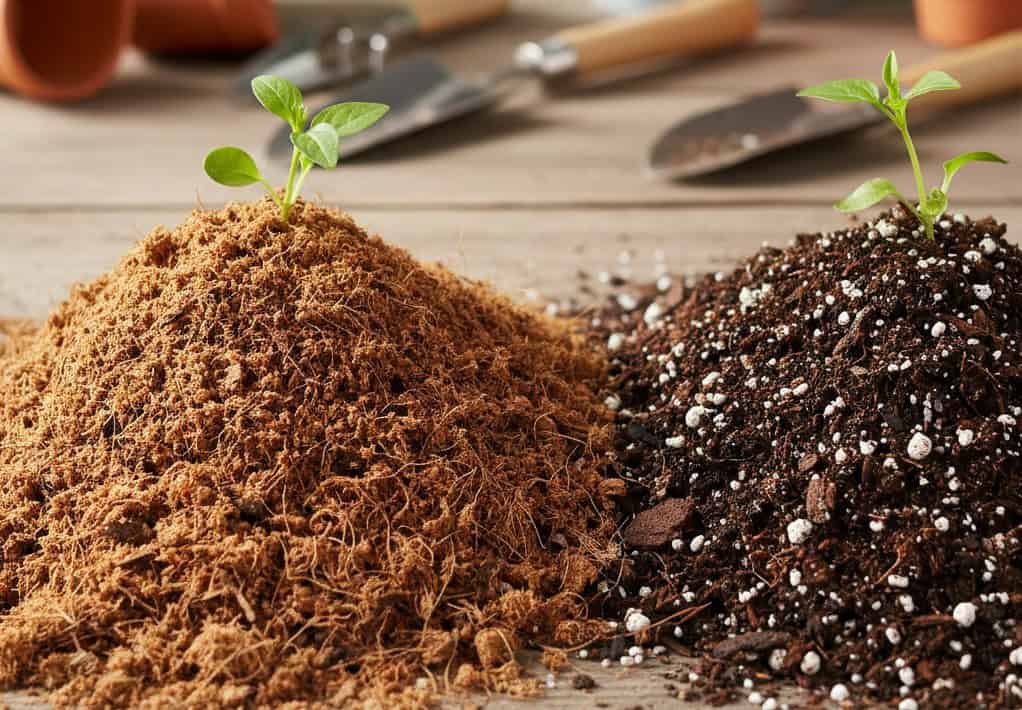
This article focuses on coco peat vs potting soil – pros, cons & which one you should use.
With coco peat and potting soil being the two most common plant growth medium, there comes a sure shot confusion. Whether you own a nursery or manage your plants at home, you must be thinking which is the best among these two.
Thus, let us help you answer your doubts with this very article. By the end of this, you will have a clear idea if coco peat or potting soil is best for your plants.
What Is Coco Peat?
Coco peat, also known as coir pith or coco coir, is a natural by-product obtained from coconut husks. When coconuts are processed for fiber, the leftover dust and fine particles are treated, washed, and dried to form coco peat. It is widely used as a soil-less growing medium in gardening and agriculture.
Coco peat is lightweight, spongy, and has excellent water-holding capacity. It can retain up to 8–10 times its weight in water, making it especially useful in dry climates or for container gardening where moisture retention is crucial. Despite holding water well, coco peat also provides good aeration, allowing roots to breathe and grow freely.
One of the biggest advantages of coco peat is that it is eco-friendly and renewable. Unlike peat moss, which is harvested from peat bogs over thousands of years, coco peat is derived from agricultural waste, making it a sustainable option.
However, coco peat is nutrient-poor by nature. It contains very small amounts of nitrogen, phosphorus, and potassium, which means plants grown in pure coco peat require regular fertilization. It also needs proper buffering and washing to remove excess salts, especially in low-quality products.
Coco peat is commonly used for:
- Seed starting
- Hydroponics
- Indoor plants
- Mixing with soil or compost
- Commercial nurseries
Coco peat can be an excellent growing medium, but not a complete replacement for soil unless nutrients are carefully managed.
What Is Potting Soil?
Potting soil, often called potting mix, is a prepared growing medium designed specifically for container plants. Regardless of the name, most potting soils do not contain garden soil. Instead, they are a blend of organic and inorganic materials formulated to provide nutrients, drainage, and structure.
A typical potting soil may include:
- Compost or organic matter
- Peat moss or coco peat
- Perlite or vermiculite
- Sand or bark chips
- Added fertilizers
Potting soil is designed to be nutrient-rich, providing plants with essential minerals for healthy growth. Many commercial mixes contain slow-release fertilizers that feed plants for weeks or months.
One major advantage of potting soil is its balanced nature. It offers water retention, drainage, aeration, and nutrients in one ready-to-use product. This makes it ideal for beginners and home gardeners who want convenience without frequent fertilizing.
However, potting soil can be heavier than coco peat, which may lead to compaction over time. Poor-quality mixes may also have drainage issues or inconsistent nutrient levels. Additionally, potting soil is generally more expensive than coco peat and has a shorter shelf life once opened.
Potting soil is best suited for:
- Houseplants
- Flowering plants
- Vegetables in containers
- Herbs
- Outdoor pots and planters
Hence, potting soil is a complete growing medium, designed to support plant growth with minimal additional inputs.
Coco Peat vs Potting Soil
| Criteria | Coco Peat | Potting Soil |
| Sustainability | High | Medium |
| Maintenance | High | Low |
| Nutrient control | Manual | Pre-balanced |
| Best for | Mixing & hydroponics | General gardening |
| Cost | Lower | Higher |
Coco Peat vs Potting Soil – Key Differences Explained
Although coco peat and potting soil are both used for growing plants, they differ significantly in composition, function, and performance. Understanding these differences helps you choose the right medium based on plant type, climate, and maintenance capacity.
- Composition and Origin
Coco peat is a soil-less growing medium made from the fibrous husk of coconuts. It is an agricultural by-product, processed into fine particles and fibers. It contains no mineral soil, making it structurally different from traditional growing media.
Potting soil, in contrast, is a blended growing medium designed to replicate natural soil conditions. It usually contains compost, peat moss or coco peat, perlite, vermiculite, bark, sand, and sometimes garden soil. The exact composition varies by brand and purpose.
This difference in composition affects everything from water retention to nutrient availability.
- Nutrient Availability
One of the biggest differences is nutrient content. Coco peat is naturally low in nutrients. It provides almost no nitrogen, phosphorus, or potassium. Plants grown in coco peat rely entirely on external fertilization for growth.
Potting soil is typically nutrient-rich, especially commercial mixes. Many such mixes contain organic compost and slow-release fertilizers. These can feed plants for weeks or months. This makes potting soil more suitable for beginners or low-maintenance gardening.
In short, coco peat is a neutral medium, while potting soil is a feeding medium.
- Water Retention and Drainage
Coco peat has exceptional water-holding capacity. It can absorb and retain large amounts of moisture while still maintaining air pockets for roots. This makes it ideal for areas with irregular watering or hot climates.
Potting soil retains moisture at a moderate level. While good-quality mixes balance drainage and retention, poor mixes may either drain too fast or retain excess water, leading to root rot.
Coco peat offers greater control over moisture, but potting soil offers greater stability.
- Aeration and Root Health
Coco peat has a loose, fibrous texture that promotes excellent aeration. Roots grow freely and receive sufficient oxygen, reducing compaction issues.
Potting soil can compact over time, especially after repeated watering. Compaction reduces oxygen availability to roots unless the mix includes perlite, sand, or bark.
For plants sensitive to root suffocation, coco peat performs better.
- pH Level and Salt Content
Coco peat is generally pH neutral to slightly acidic, suitable for most plants. However, low-quality coco peat may contain excess salts and requires washing or buffering.
Potting soil pH varies depending on ingredients. Some mixes are tailored for specific plants like roses or succulents, while others may require adjustment.
Both media may need testing, but coco peat demands more preparation.
- Sustainability and Environmental Impact
Coco peat is considered highly sustainable because it uses coconut waste and is renewable. It is biodegradable and environmentally friendly.
Potting soil sustainability depends on its ingredients. Mixes containing peat moss raise environmental concerns due to slow peat regeneration.
From an eco-friendly perspective, coco peat has a clear advantage.
- Ease of Use and Maintenance
Potting soil is ready to use straight from the bag, making it ideal for home gardeners. Coco peat requires soaking, buffering, and consistent fertilization, which increases maintenance.
Potting soil favors convenience; coco peat favors control. But if you have experience of gardening and managing plants well, maybe you can give a try to coco peat.
Pros and Cons of Coco Peat
Pros
- Excellent water retention
- Lightweight and easy to handle
- Improves soil aeration
- Eco-friendly and renewable
- Resistant to fungal growth
- Ideal for seed germination
Cons
- No natural nutrients
- Requires frequent fertilization
- Needs buffering and washing
- Not suitable alone for long-term plant growth
- Can dry out quickly in hot weather
Coco peat works best when mixed with compost, vermiculite, or soil rather than used alone.
Pros and Cons of Potting Soil
Pros
- Nutrient-rich and ready to use
- Suitable for most plants
- Minimal maintenance
- Good moisture balance
- Widely available
Cons
- Heavier than coco peat
- Can compact over time
- Quality varies by brand
- Less eco-friendly in some mixes
- May need replacement every season
Potting soil is ideal for gardeners who want a complete solution without constant monitoring.
Comparison table
| Feature | Coco Peat | Potting Soil |
| Type | Soil-less medium | Soil-based or blended medium |
| Nutrients | Very low | Medium to high |
| Water retention | Very high | Moderate |
| Drainage | Excellent | Depends on mix |
| Weight | Very light | Medium to heavy |
| Eco-friendly | Yes | Depends on ingredients |
| Fertilizer required | Yes | Sometimes |
| Best use | Mixing, hydrophonics | Ready-to-use planting |
In this article on Coco Peat vs Potting Soil – Pros, Cons & Which One You Should Use, we have tried to answer which one can be the best. Coco peat and potting soil are not competitors but complements. Coco peat improves structure and moisture, while potting soil provides nutrients and stability. The preferred choice depends on your plants, experience level, and gardening goals.
If you want control and sustainability, choose coco peat with amendments. If you want convenience and reliability, potting soil is the better option.
Have you been looking for a reliable source to buy either of these? Earth Scape can be a solution to it. Please visit the official website to know more.
FAQ
Is coco peat better than potting soil?
No. Coco peat is better for aeration and moisture control, while potting soil is better for nutrients and ease of use.
Can coco peat replace potting soil completely?
Not alone. It must be mixed with compost and fertilizers.
Do plants need fertilizer when using coco peat?
Yes. Fertilizer is essential.
Is coco peat good for all plants?
No. Heavy feeders and woody plants need nutrient-rich soil mixes.

Editorial Staff
Editorial Staff at Earth Scape are experts in coco peat.